My Personal Experiences as a See Jay Company Tour Guide
by Aki Wakabayashi
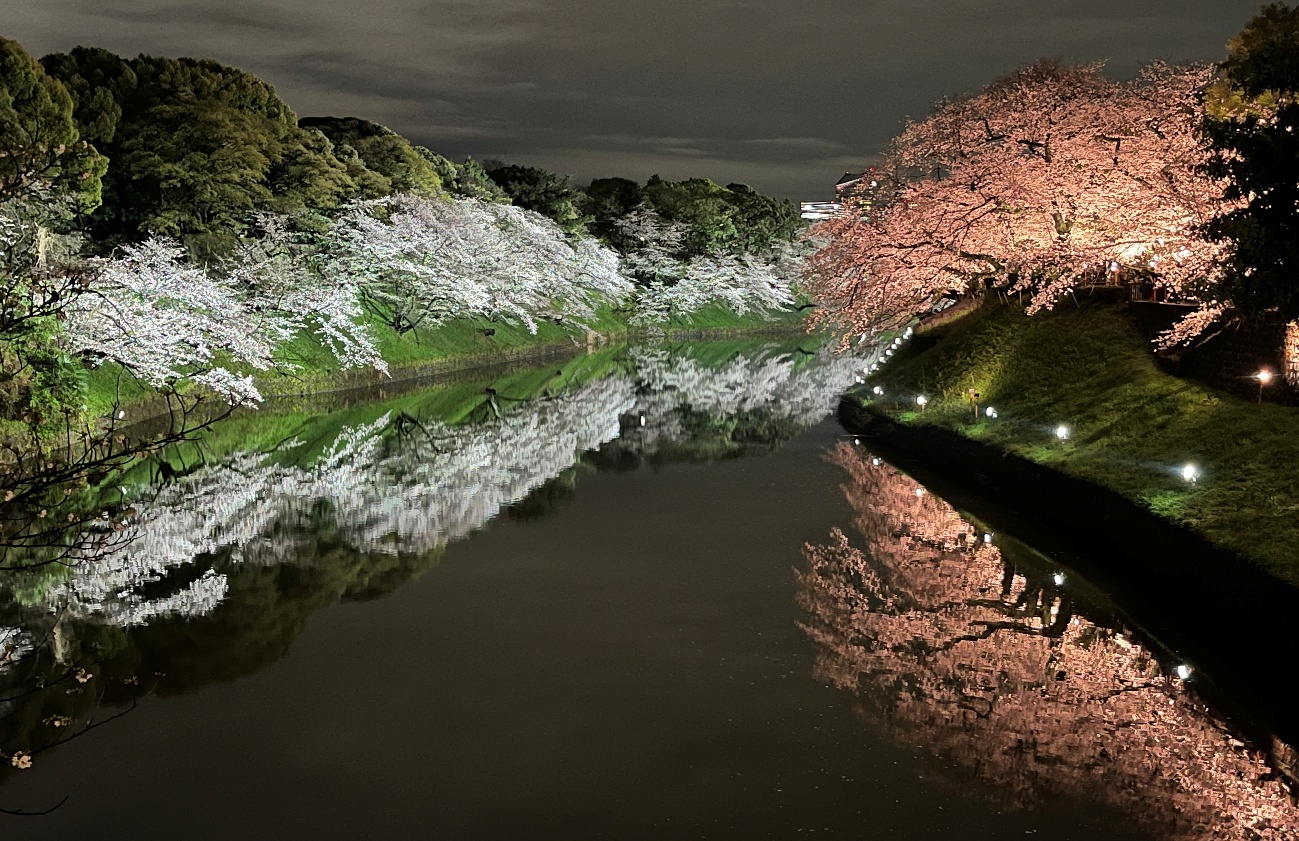
Night Cherry at Chidorigafuchi Imperial Palace
What’s Important in Being a Tour Guide
Currently, I’m working for my son’s tour guide company, teaching new guides the know-how and tips of the
job. Our work involves guiding foreign tourists who come to Japan, all in English. I’ve put together my
thoughts and experiences here in the hope that it might be helpful.
I believe there are two important things when it comes to guiding:
• “Acting from the guest’s point of view”
• “Opening your heart to strangers and building a relationship like a friendship”
• “Accommodating special requests under almost all circumstances”
Listen Honestly to the Voice of the Guest
There’s no single answer to the question, “What makes a good guide?” Because if there are 100
people,
there are 100 different ways of guiding. However, since we’re getting paid to guide, what the guest feels
is the most important thing.
Most people who come to Japan and hire a guide are visiting for the first time and don’t know what to do,
so they look for help. When they’re planning their trip, they usually check travel agency websites and
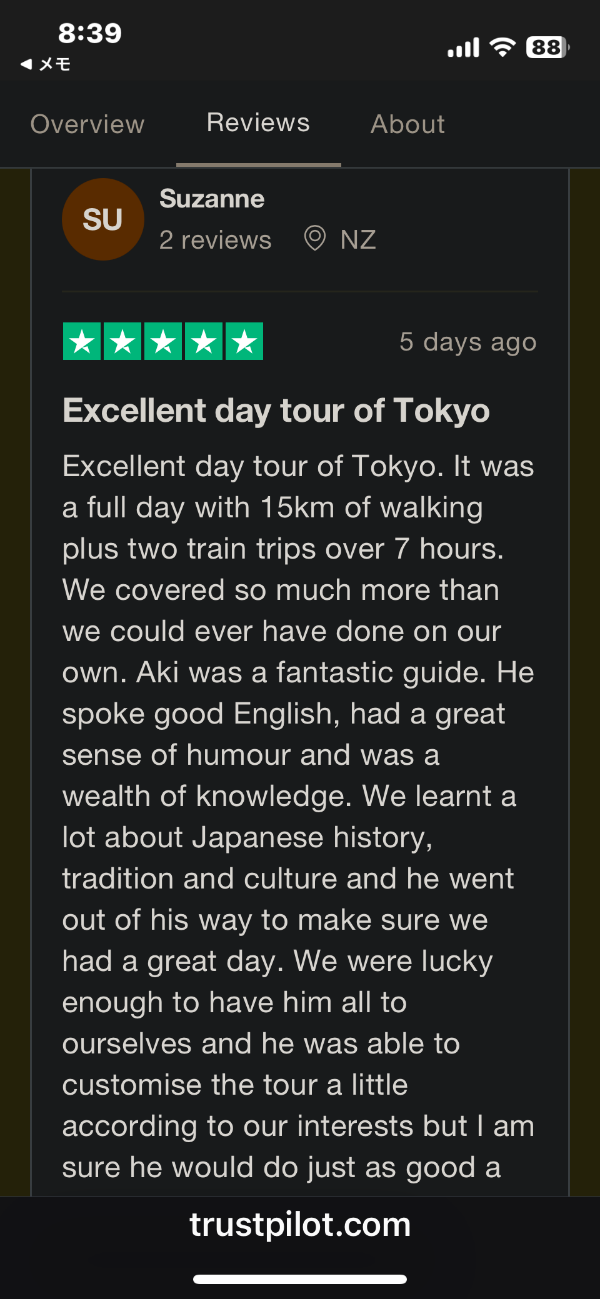
rely heavily on reviews to choose the tour and the guide. Reviews are where you can hear guests’ honest
opinions. That’s why even things they can’t say directly to the guide—like “the guide’s English
pronunciation was terrible, and I couldn’t understand what they were saying”—get written there. So, the
key to becoming a good guide is not to judge yourself, but to sincerely listen to the guests’ feedback.
Act Based on How the Guest is Feeling
When tourists have a good impression of Japan, it’s often because they feel it’s “safe,” “clean,” “people
are kind.” I’ve often been requested by guests or travel agencies, and I believe it’s because my way of
working is rooted in the spirit of omotenashi—Japanese hospitality.
The spirit of omotenashi is about sensing what the other person is feeling and acting accordingly. In
Japan, if you can’t sense others’ feelings and act on them, it’s hard to get along in society. Parents
raise their children with this in mind.
When guests are in trouble, I help them after the tour at no charge. For example, if someone says, “I
don’t know how to print my Shinkansen ticket using this QR code—Aki, can you help me?” I’ll go with them
to Tokyo Station even after the tour has ended. I don’t get paid overtime for this. I simply do it out of
goodwill. I was raised to believe that helping people in need is a good thing.
If time allows during the tour, I’ll often take guests to interesting places that are’t on the original
itinerary. As a result, tours often run 30 minutes to an hour over. So why spend my own time and energy
doing things that don’t profit me? It’s because that’s the spirit of omotenashi. Simply put, it means
“finding joy in what brings joy to your guests.” This is something we naturally do for our parents,
children, partners, and close friends. The spirit of omotenashi means applying that same attitude to
people outside your family, even in your work.
Love Your Work as You Love Your Family
In Japan, we learn by watching our parents that if you love your work like you love your
family, you grow
as a person. My parents always told me, “If you do good work, it will always lead to happiness for your
family and good fortune.”
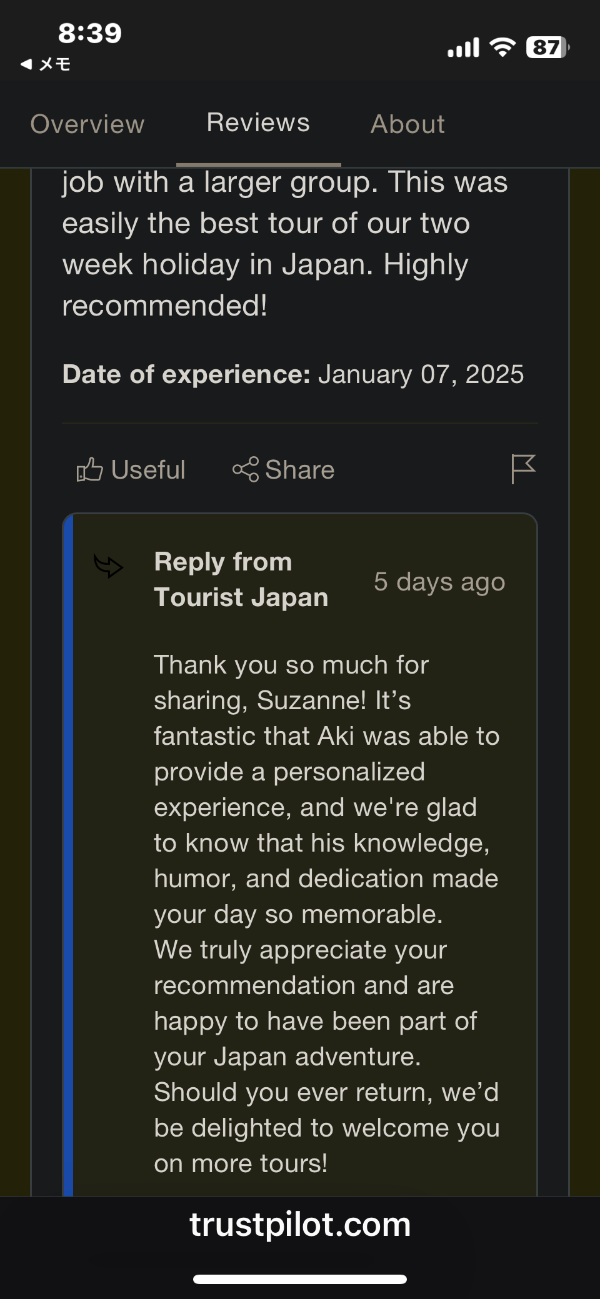
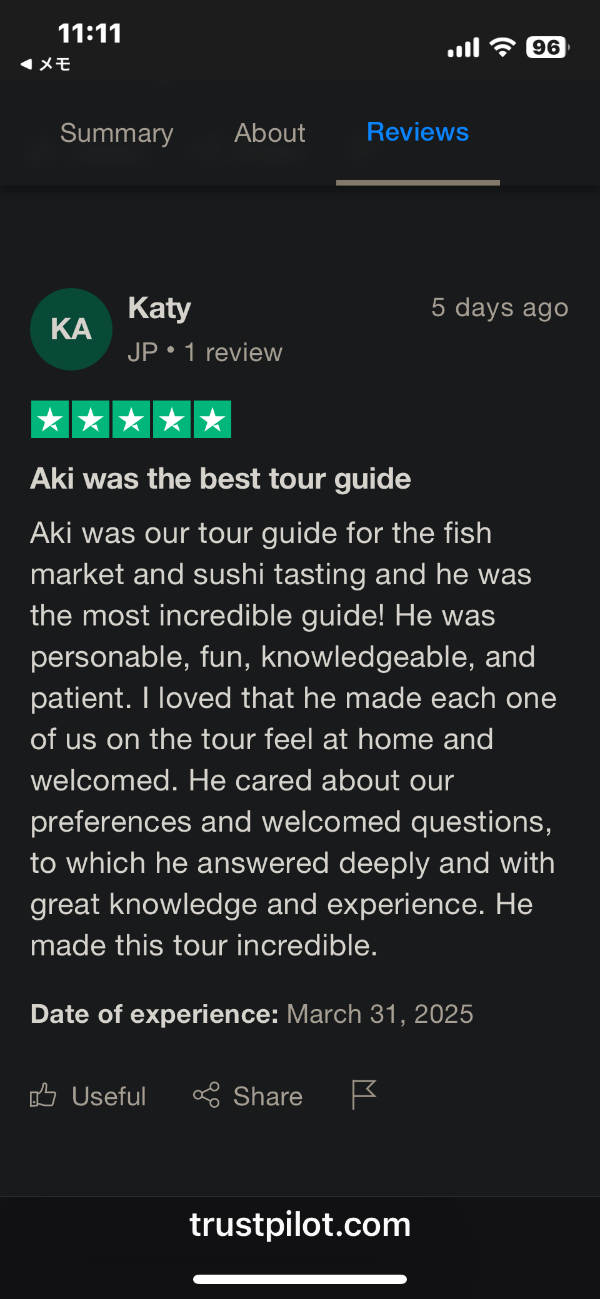
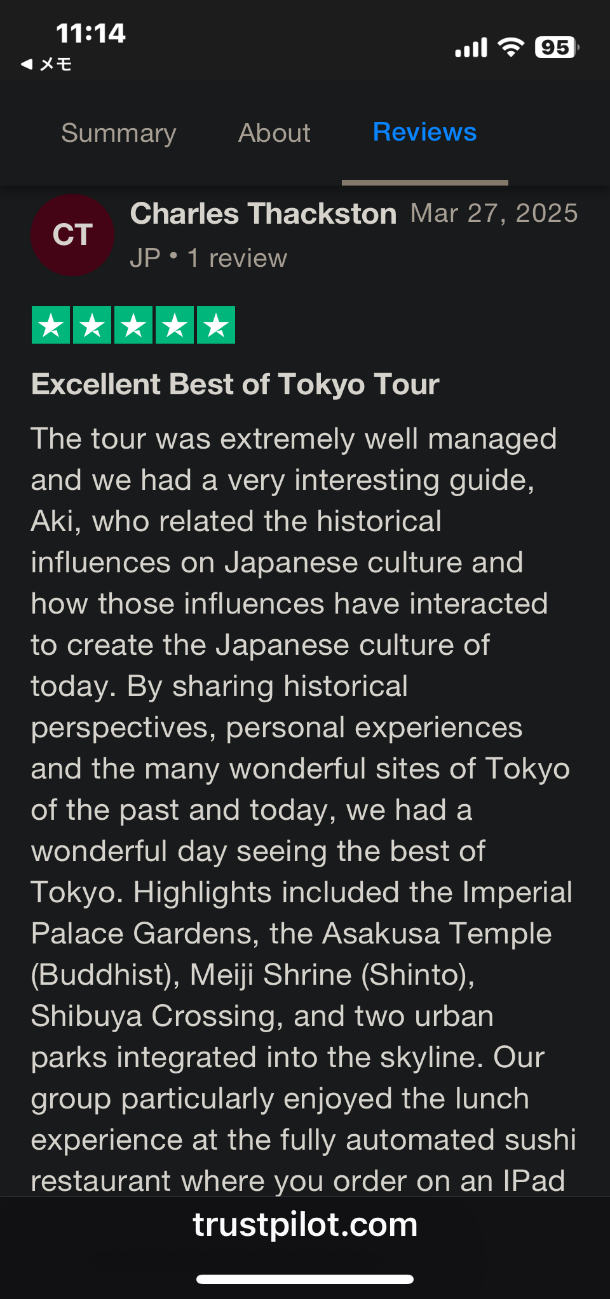
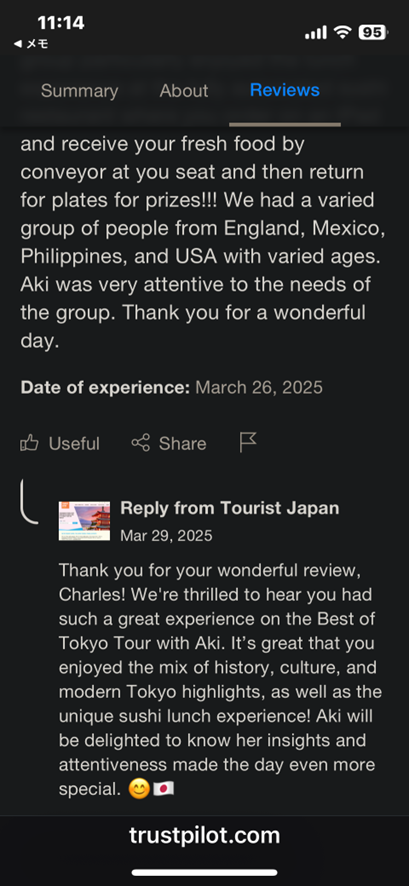
When I serve guests with the spirit of omotenashi, they often write about it in their reviews. These
reviews not only make me happy—they also come with real benefits. Guests who are moved by the tour and my
hospitality often recommend me to their family and friends when they visit Japan. Travel agencies
overseas, too, will request me specifically when they hear from their customers, “That guide was amazing.”
As a result, I get more work. Good reviews are proof that people enjoyed the tour I gave, and there’s
nothing more rewarding than that.
That’s why it’s so important to prioritize the guest over yourself and act with a spirit of omotenashi.
Doing so makes the work enjoyable, and the guests are grateful in return.
When you truly enjoy guiding, that joy always reaches your guests.
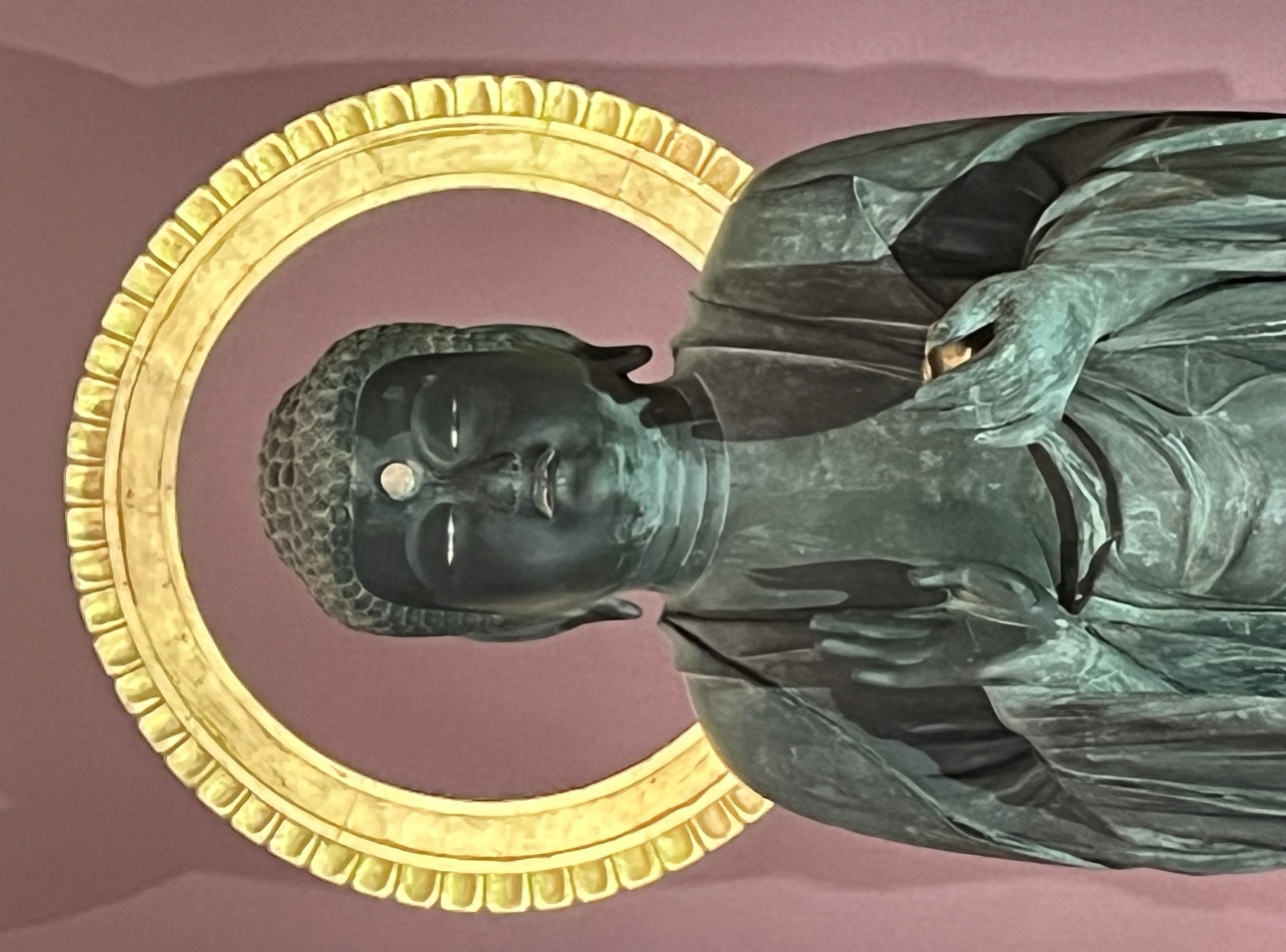
Kitakamakura Enkakuji Yakusi nyorai
Personal Experiences as a Tour Guide
The Key to Being a Good Guide is “Doing Your Best with What’s in Front of You”
Yesterday, I had Elena, an Italian guide from my son’s company, accompany me on a tour. She is very
dedicated to her studies and is constantly learning. Because of that, she has a wealth of information and
provides outstanding tours—so much so that she frequently receive excellent reviews from guests.
She’s also highly skilled on the administrative side. She handles negotiations with difficult business
partners very smoothly. Lately, I’ve stopped handling those negotiations myself and have left everything
to Elena. She also manages the day-to-day tour schedules, so the company really couldn’t function without
her.
One day, we were talking about what it takes to be a good guide, and an interesting idea came to mind. “If
your family or friends came from Italy to visit Tokyo and ran into trouble, you would do everything you
could to help them, right? You should treat your guests with that same mindset.”
And in the end, I told her “The key to being a good guide is simply to do your best in the moment.”
At the end of the day, I asked her how she felt about the tour. She replied,
“You’re more Italian than I am.”
I didn’t ask what she meant by that, but I took it as a compliment—maybe she meant that I live and speak
with passion. That said, if she meant it because I act too casually with guests, crack edgy jokes
non-stop, and enjoy their reactions… well, in that case, I apologize! (lol)

View of Mt Fuji from peak of Mt Takao(800m) Tokyo
Accepting Others
Yesterday’s tour covered the Imperial Palace, Asakusa, Meiji Shrine, Harajuku, and Shibuya—all
in one
day. Recently, with the cherry blossoms in full bloom, the number of tourists has increased, and we had
over 20 bookings. So, I split the group in two with Elena.
Among the 11 guests I took care of, there was a very kind-looking American lady. She was extremely
enthusiastic about learning and had filled a notebook with a list of things she wanted to do in Japan. At
first, when we were having lunch at Kura Sushi, she checked her notebook and asked, “Do you have natto
rolls? How about salmon with cream cheese?” I told her, “Natto is something even Japanese people have
mixed feelings about. It’s actually quite a difficult sushi to enjoy.” But she replied, “My friend told me
I must try it, so please order it.” When she tasted it, she liked it and looked very happy.
When it comes to food, there’s no problem, but in the afternoon, she started expressing her preferences
for places to visit. After Meiji Shrine, on our way to Harajuku, I said, “We’ll go from Omotesando to Cat
Street,” but she looked at her Japan-travel notebook and said she wanted to go to Takeshita Street
instead.
Since we had already changed the morning course and visited Chidorigafuchi for cherry blossom viewing, we
were running late, and I didn’t want to take a detour.
So I told her, “Takeshita Street is a place where young people hang out. Adults may not find it very
enjoyable. Omotesando has lots of high-end brands, and Cat Street has unique shops by young designers—it’s
quite interesting.” But she insisted, “I’m not interested in high-end brands. I want to go to Takeshita
Street.”
If it were the younger me, I would have argued and rejected her request, sticking to my original plan. But
recently, I’ve come to think: if a guest has done that much research, I want to honor their wishes. I’m
learning to put myself in their shoes. So I first asked everyone, “Is it okay if we don’t finish on time
and go a bit over?” When they agreed, I took the group to Takeshita Street. Everyone had a great time.
Since it was already close to the end of the tour, I thought about wrapping up by taking the subway to
Shibuya Crossing. But seeing how much fun they were all having—especially the American lady—I decided to
go all in with them for the rest of the day. So I canceled the subway plan and decided to walk to Shibuya,
taking about an hour with some detours.
When we reached the Omotesando crossing from Takeshita Street, everyone was fascinated by the jungle-like
Tokyu Plaza building on the corner. I said, “Today is a VIP tour, so we’ll go up that jungle building and
experience it!”—which made everyone cheer. The lady asked, “But isn’t there a huge line to get in?” I
replied, “You’re VIPs today—my face is our ticket!” That got a good laugh.
When we went up Tokyu Plaza and experienced the “urban jungle,” they were amazed that such a place exists
in the middle of the city. The interior was also beautifully designed, and it really captured the essence
of Harajuku as a hub of fashion culture. Though the tour was already supposed to be over, I thought,
“Let’s just do everything we can!”
We went to Cat Street, and I said, “This street is full of stylish shops by young designers—very
charming.” On the way to Shibuya, we stopped by Miyashita Park on a rooftop near the station. The group
had fun watching pairs of high school girls filming TikToks on the benches. Then, when we passed a narrow
alley with old pubs near the train tracks, a South American gentleman complained, “I’m tired—I want a
beer.” I teased him, “We’re still on the tour, kid! Save the drinking for after, baby!” That joke got a
big laugh from everyone.
At Shibuya Scramble Crossing, everyone was super excited. There were so many tourists we couldn’t cross in
one light cycle, so we waited by the roadside railing. A security guard came and told us, “Please move
from this spot.” I apologized, saying, “Sorry, we couldn’t cross because it was so crowded,” and he smiled
and said, “I understand.” Everyone thanked him with a smile. After crossing in two green light cycles, we
ended the tour by taking the Inogashira Line walkway to look down over the crossing.
As we said our goodbyes, the American guest told me, “You don’t do this job just for the work—you truly
enjoy interacting with us. You take us to interesting places and genuinely enjoy watching us enjoy it. I
could feel that, and today was absolutely wonderful. I’ll leave you a great review.”
Everyone seemed to sense that I was giving it everything I had—partly driven by the energy of that
enthusiastic lady. But I couldn’t just ignore someone who had studied so much about Japan and joined the
tour with clear hopes of what she wanted to experience. She was probably the most prepared and eager guest
I’ve ever guided.
I realized that she was, in a way, a teacher for me—a teacher helping me become a more professional guide.
She gave me a valuable lesson: “How far can I set aside my own preferences to serve someone else?” Her
passion brought out the best in me. When I shook hands with everyone at the end of the tour, their words
were the greatest reward:
“Thank you for going all out today.”
“I could never have had this experience on my own—I’m so glad I came.”
“It was amazing—I’ll write you a great review.”
I realized again that when you give your best, good things come in return.
Above all, the sense of fulfillment from having given it my all—that was the best feeling of all.
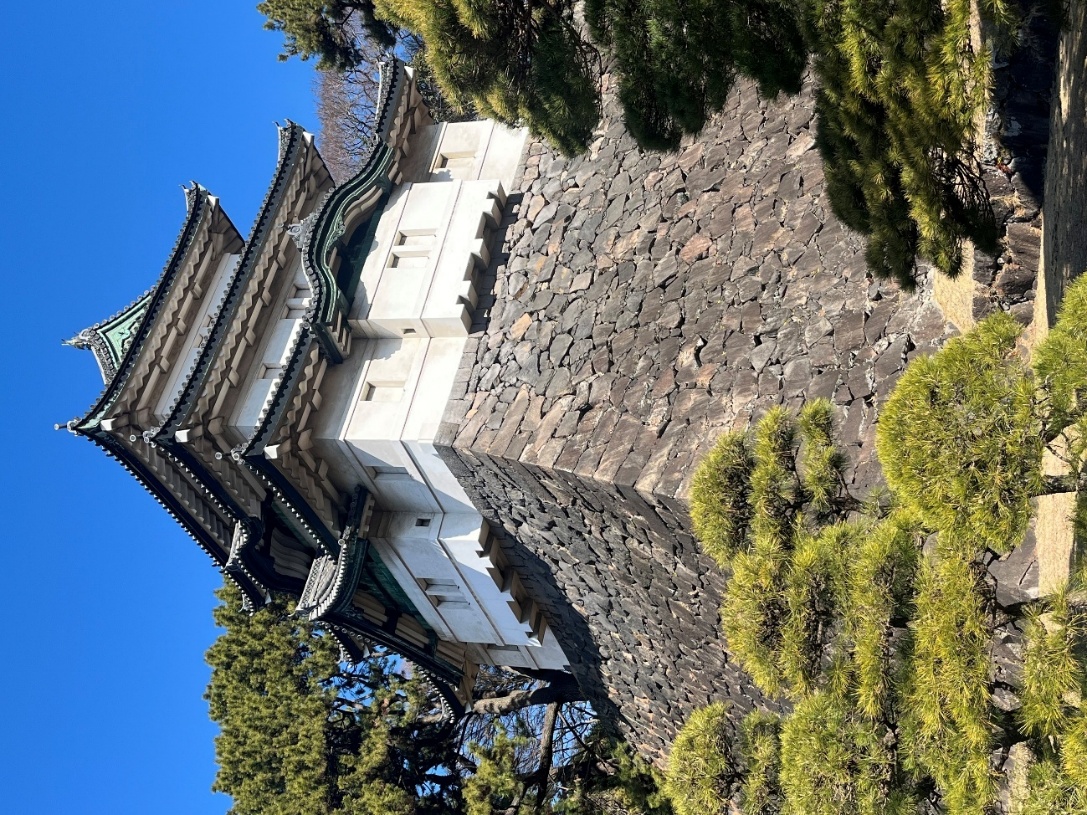
Imperial Palace
The Strongest Newcomer Appears
Recently, four new guides joined See Jay company. Since Seiji asked me to train them, I’ve been conducting
training sessions with them for the Tokyo One-Day Tour (a full-day tour of Tokyo’s landmarks) and the
Tsukiji Fish Market Tour (including visits to Higashi Honganji Temple, the market, lunch, and Kabukiza
Theater).
One of the new guides, Mary, is a professor of cultural anthropology at a university and specializes in
Japanese culture. Because of her deep knowledge, even during training, I often let her explain historical
and cultural topics instead of me! Since she is a professional educator, she was incredibly skilled at
communicating with people.
One day, during a Tsukiji Fish Market Tour, a guest mentioned that Mary had been their guide for the Tokyo
One-Day Tour the previous day. The guest said, “During the tour, when we mentioned wanting to stop for
tea, she happily joined us. She accommodated all our requests and extended the tour from the scheduled 4
PM end time to 6 PM. By the time we arrived at Meiji Shrine, the gates were closed, so we couldn’t go
inside. But that was only because we spent extra time at a café, and overall, we were extremely satisfied
with the tour.”
Usually, guests complain when they can’t visit all the locations listed in the itinerary. However, going
above and beyond in service and receiving gratitude for it is truly remarkable. I also try to embody the
spirit of hospitality, and sometimes I extend a tour scheduled to end at 4 PM until around 5 PM—of course,
after checking the guests’ post-tour plans. But extending it until 6 PM? That’s on another level entirely!
Learning about life through work
The way we evaluate extending a tour depends on whether we see guiding as merely a job or as a way to
learn about life through work. Since I view it as the latter, I don’t believe that strictly adhering to
the scheduled end time is the only correct approach. If the guests are happy and their schedule allows it,
I enjoy walking through the city with them.
For many Westerners, business is seen as an exchange of time for money. So when a guide exceeds the
scheduled time without asking for additional payment and genuinely enjoys guiding, they find it deeply
moving and generous. Many positive reviews mention this: “The guide extended the tour by 30 minutes.”
“They continued guiding for an extra hour.”
But extending a seven-hour tour by two whole hours? That’s something you can only do if you see guiding as
a passion rather than just work. It made me realize how incredible Mary is. Since she is a university
professor, I believe she genuinely loves sharing knowledge and teaching others.
One time, I joined a tour led by another foreign guide who always receives great reviews. He was extremely
knowledgeable about history and gave a flawless presentation. The tour ended thirty minutes early, but
after experiencing such a perfect presentation, I completely understood why he gets such high praise.
So in the end, I realized that what truly resonates with guests isn’t the length of the tour, but rather
how passionate the guide is—and whether the guide is genuinely enjoying the tour themselves.
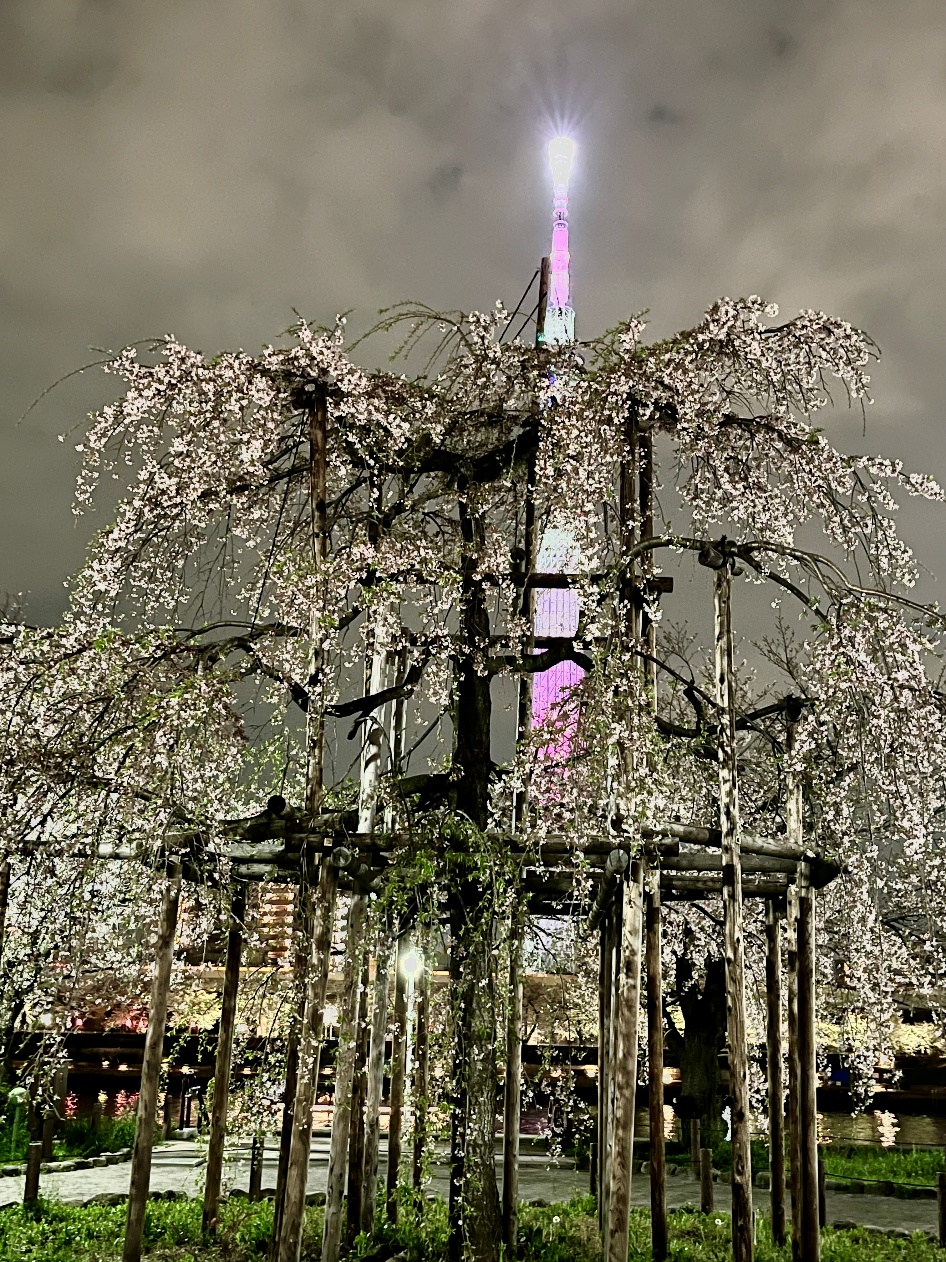
Miharu sidaresakura at Sumida Park(near Kototoi Bridge)
Providing Top-notch Entertainment
I often conduct tours to typical tourist spots. However, I pour my heart and soul into ensuring that
guests have the best possible experience. I tell edgy jokes that might catch them off guard, playfully
engaging them and eliciting laughter as we proceed. Additionally, I use descriptive language to help
guests imagine they’ve time-traveled to the Edo period, guiding them to use all five senses to fully
experience the setting.
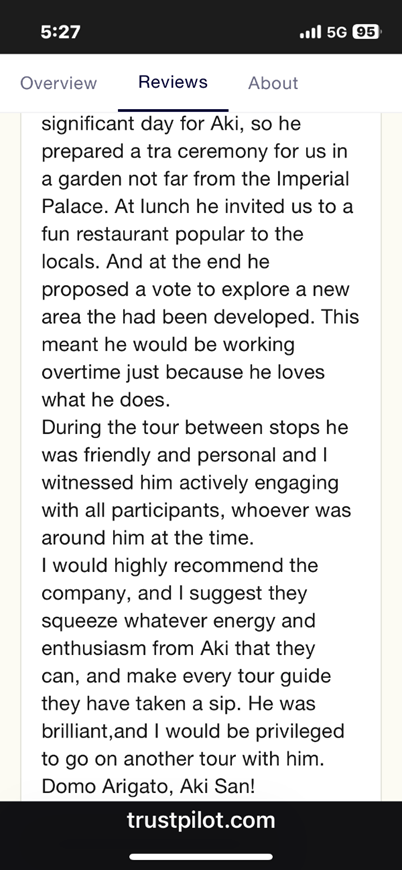
At the Imperial Palace, we walk across the plaza envisioning ourselves as samurai from the Edo period
going to meet the shogun. We proceed over the Wadakura Bridge, through the Kikyo and Sakashita Gates,
treading on gravel paths, crossing the Nijubashi Bridge, and ascending to the main enclosure of Edo
Castle.
In Asakusa, I encourage guests to imagine themselves as commoners from the Edo period, excitedly strolling
through Nakamise Street as if visiting a modern-day theme park, experiencing the temples, statues, and
gardens like attractions.
At Meiji Shrine, instead of taking the main Omotesando route, we walk along a side path to the left of the
entrance torii gate, leading to the main shrine. This path runs adjacent to the Yoyogi Park Bird
Sanctuary, making it feel like a woodland trail. For about ten minutes before reaching the main shrine, we
walk in silence, focusing on the sounds of birds chirping, meditating as we go. I explain that purifying
the mind before visiting the shrine enhances the experience, and guests, taking this to heart, focus
earnestly. After cleansing their minds, they purify their bodies at the temizuya (water pavilion) before
offering their prayers.
In Harajuku, we explore the ultra-stylish Tokyu Plaza, a building reminiscent of a jungle, located at the
corner of Omotesando and Meiji-dori. Afterward, we stroll through Cat Street, lined with trendy shops from
up-and-coming designers.
Before reaching Shibuya, we walk through the delightful Miyashita Park, a rooftop space atop a three-story
building. Here, high school girls sit on benches, recording dance videos with hand signs for TikTok,
either in their uniforms or dressed up. In Shibuya, I introduce Center Street in a way that syncs with
modern Japanese youth culture and consciousness. The tour concludes by crossing the Scramble Crossing,
allowing guests to swiftly transition from traditional Japanese experiences to the most fashionable and
vibrant district in Tokyo, highlighting the contrast for their enjoyment.
Given the large number of participants, there’s limited time to have deep conversations with each
individual, but I conduct the tours with the hope that everyone enjoys them to the fullest.
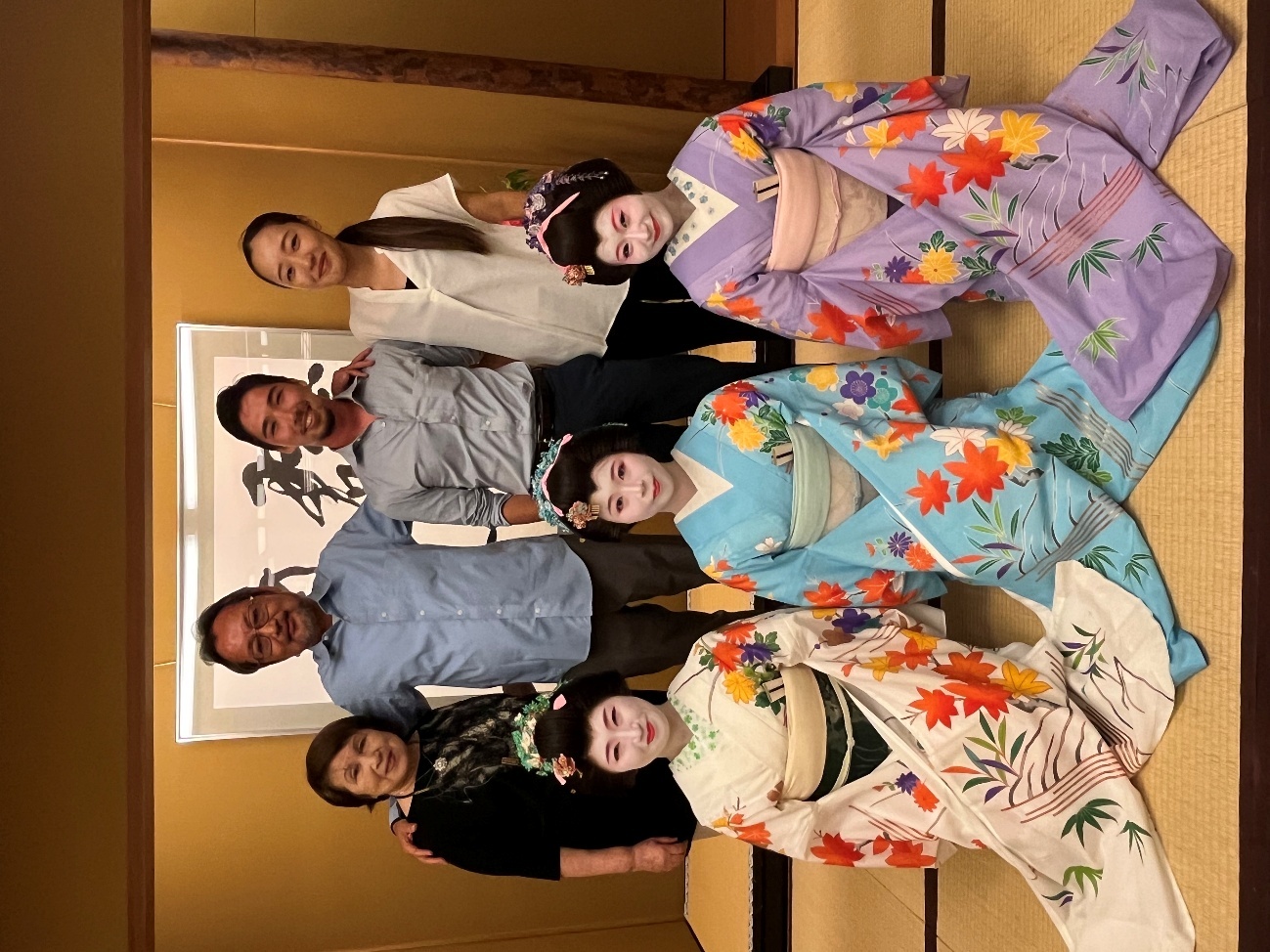
Geisha Experience Tour
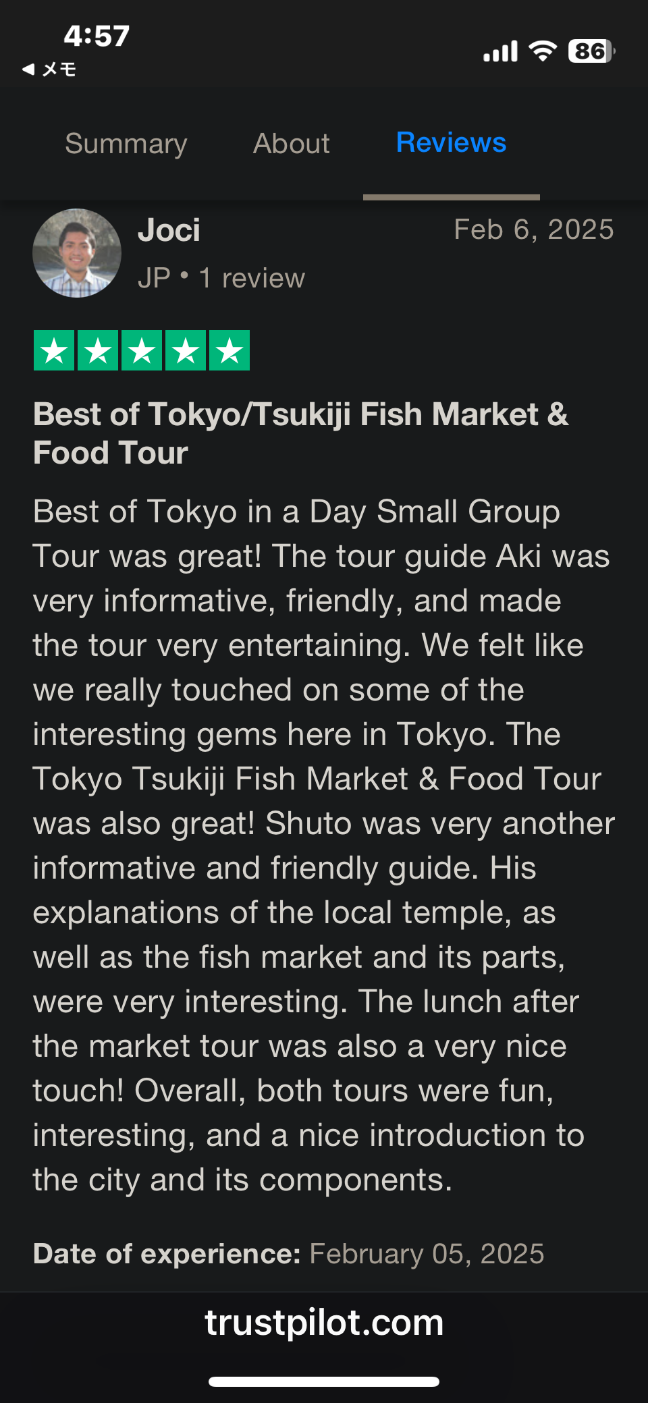
When Someone I’ve Helped is Praised, It Makes Me Happier Than Being Praised Myself
Through an introduction from a friend, a professional guide named Shuto started working with us. The other
day, I joined him on a tour of Tsukiji Fish Market to explain the course. Shortly after, he received a
great review. He’s an honest, sincere, and curious person. His tours have a relaxed and easygoing
atmosphere, and because his style is the complete opposite of mine, I learn a lot from him. He has a
strong drive to learn and absorb new things with a very positive energy. On top of that, he’s tall and
handsome!
He has many years of experience as a guide, so it’s no surprise that he gets great feedback from guests.
But I realized something—when someone I’ve helped receives a good review, it makes me as happy as when I
receive one myself. Since this story involves Tsukiji Market, let me briefly explain what it’s like for
those who may not be familiar with it.
The Current State of Tsukiji Outer Market
At Tsukiji Outer Market, some eateries have outdoor seating exposed to the cold winter winds,
while
others offer plastic windshields for a bit of protection. In the case of sushi restaurants, the cheaper
ones often have a modest appearance, while the more visually appealing ones cater to tourists with
high-priced dishes made from premium ingredients.
For example, a uni (sea urchin) rice bowl with about 30 pieces of uni costs around 10,000 yen.
The “Emperor Bowl,” which includes additional ootoro (fatty tuna) and ikura (salmon roe), costs 20,000
yen.
There’s even a skewer of grilled wagyu beef—about the size of a chocolate bar—topped with fresh uni,
selling for 8,000 yen per skewer. At this point, anything goes!
While Tsukiji takes pride in not engaging in price gouging, seeing heaps of uni placed on wagyu beef can
feel somewhat excessive from a Japanese perspective. That’s why I honestly tell my guests, “This is like
putting a ton of caviar on a steak—I’ve never tried it myself.”
See Jay Company’s Policy
As guides, our goal is to provide guests with the best possible experience, which is why we
make sure to
explain the current state of Tsukiji Market.
We tell them, “The market itself is lively and fascinating, but for lunch, we will take you to the best
sushi restaurant in town.” Instead of dining at the tourist-heavy market stalls, we guide them to a
long-established sushi restaurant outside the market.
We also explain that, from a Japanese perspective, the prices inside Tsukiji Market can be quite high.
Typically, an office worker in Japan can enjoy a sushi lunch for under 1,000 yen. If you spend 3,000 yen
on sushi for lunch, you can expect to have a high-quality meal by Japanese standards.
Foreign tourists generally appreciate practical, everyday insights more than lengthy historical
explanations. That’s why, when guiding at Tsukiji, we always make sure to mention the prices of fish and
other market goods.
In addition to exploring the market, we also visit nearby cultural landmarks such as Tsukiji Honganji
Temple and Kabukiza Theater (just a five-minute walk away), where we share insights into Japanese history
and culture.

Kei collection Paris at Azabudai hills
Lunch Experience at Tsukiji Market with a Guest Who Can’t Eat Sushi
One day, I have a tour myself at Tsukiji Market with nine guests. It’s a bit of a challenge to keep
everyone together in the crowded market with that many people.
We’re meeting at Tsukiji Station at 10 a.m. in the morning.
It turned out that four people were vegetarians who couldn’t eat fish, meat, or eggs. In such cases, I
usually take them to my go-to sushi restaurant, where they can have vegetable sushi like kappa maki
(cucumber rolls) and oshinko maki (pickled radish rolls).
I told them, “I’ll take you to the best sushi restaurant in Tsukiji, and they will make special vegetarian
sushi for you.”
They asked, “What kind of sushi is that?”
I explained, “It’s sushi made with vegetables, vinegared rice, and seaweed.”
Then, one of them said, “I can’t eat seaweed.”
At that moment, my entire backup plan was ruined. Normally, when guests join a Tsukiji Fish Market Tour
but can’t eat fish—or even seaweed—it becomes very difficult to provide them with a proper lunch. Since I
was occupied with guiding, I called the operations manager at See Jay Company and asked them, “Can you
find a restaurant near Tsukiji that serves vegetable dishes and send me the link?”
While staying in touch, I guided them through Tsukiji Honganji Temple and the fish market before heading
to lunch. Five members of the group could eat fish, so I took them to my usual sushi restaurant and
ordered sushi for them. I told them,
“After finishing your meal, let’s meet in front of the Lawson convenience store at 1 PM.” Then, I left the
sushi restaurant.
Becoming a “Food Refugee”
Next, I walked about 15 minutes with the four vegetarian guests to a restaurant in Ginza, which had
“Vegetable Restaurant” written on its website. However, when we arrived, the staff told us, “During lunch
hours, we serve a lot of vegetables for the nearby office workers, but all of our set meals include meat
or fish.”
After walking all that way, the restaurant turned out to be unsuitable. On Ginza Street, I noticed a beer
hall displaying pizzas in its showcase. I asked them, “How about a pizza with just cheese?” They
responded, “That would be okay.”
However, when I asked the staff if they could make a cheese-and-vegetable-only pizza, they said, “The
salami is added during the preparation stage, so we can’t make a plain cheese pizza.”
By now, I realized that finding a vegetarian restaurant in Ginza was nearly impossible. So, I called a
vegetarian restaurant in Hibiya to ask if they could reserve a table. But they replied, “We don’t take
reservations during lunch hours.”
At this point, we had been “food refugees” for over 45 minutes.
Thinking of Alternatives
Since there were no vegetarian restaurants in Ginza, I considered the following alternatives:
1. Go to an Italian restaurant and order pasta without meat, fish, or eggs.
2. Buy bread, tofu, and vegetable sticks from a convenience store, mix them with dressing, and make
sandwiches. Then, we could eat them at the rooftop garden of Ginza Six, which offers a panoramic view of
Ginza. I would say, “No other traveler in Japan has had this unique experience!” to lighten the mood and
prevent them from regretting not having sushi.
It felt like a checkmate situation in a chess game—I was close to losing.
So, I honestly told them, “It’s very difficult to find a vegetarian restaurant in Ginza.”
The Guest’s Suggestion
Then, the guest said, “Aki, you tried your best to find a vegetarian restaurant for us. And when that
didn’t work, you thought about what else we could do in Ginza. But we don’t want to waste any more of your
time. If you give us the lunch budget set by the travel agency, we’ll find a place on our own. Let’s end
the tour here.”
Hearing this, I felt relieved. I had already thought it was impossible to find a vegetarian restaurant in
Ginza. If we were in a more casual area, we could go to a family restaurant like Saizeriya, but in Ginza,
there were no such options.
From a tour company’s perspective, people join a Tsukiji tour expecting to see the market and eat sushi.
Therefore, vegetarian options are not prepared in advance. However, once the tour starts, as the guide in
charge, I believe we must take full responsibility, just like a ship’s captain. We must find a way to
solve the problem ourselves.
Doing Your Best for the Guest
This experience taught me that the best way to resolve an issue is to put yourself in the guest’s position and do everything you can. Even guests who initially complain a lot will eventually feel, “If you tried this hard and still couldn’t do it, then it can’t be helped. ”When guests see the effort I put in, they change their mindset and accept the situation.
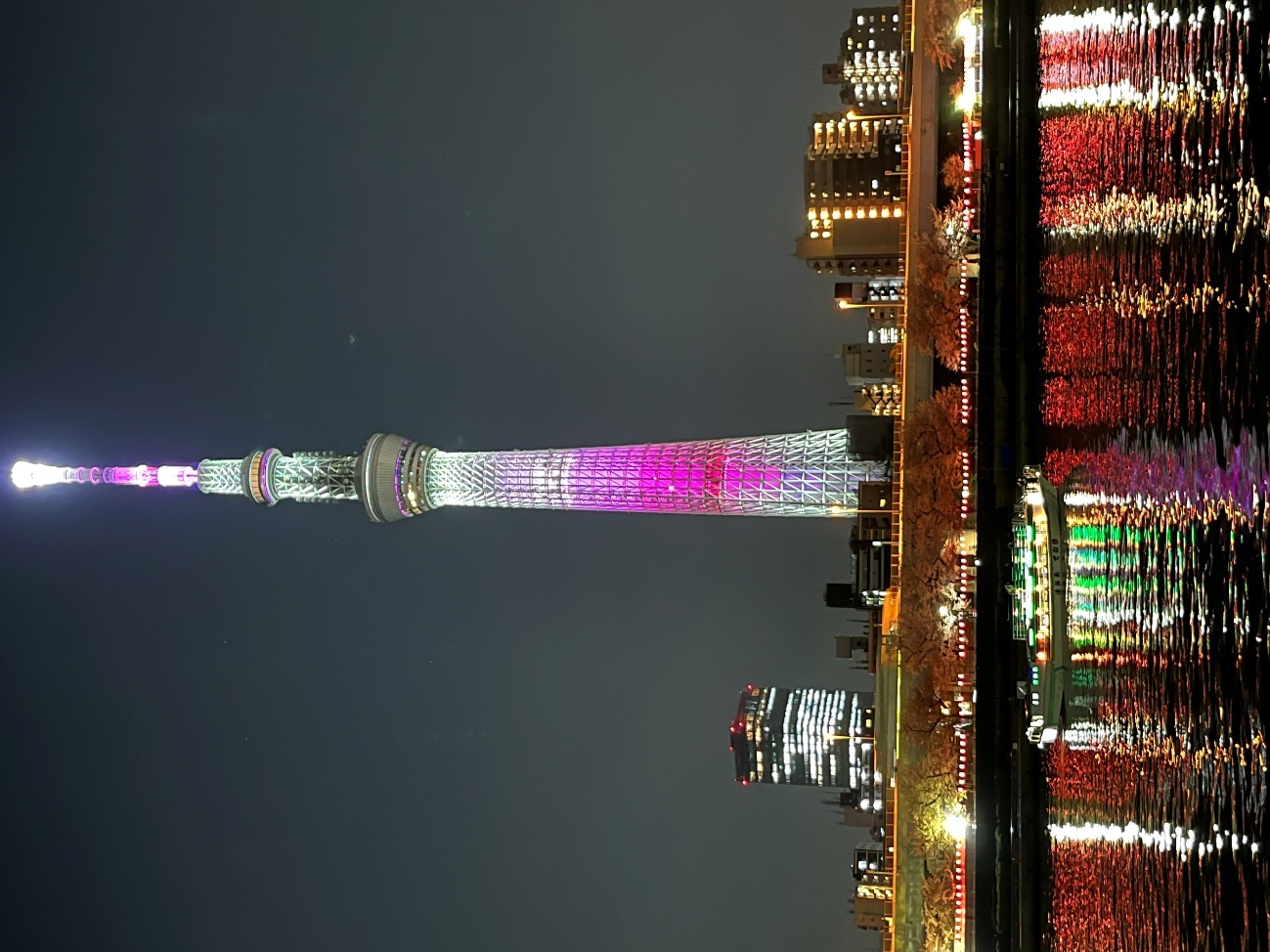
Sumida River Party Boat and Sky Tree
A Young Guide’s Story That Moved Me
Yesterday, I led a Tokyo One-Day Tour with a guest, visiting the Imperial Palace, Asakusa, Meiji Shrine,
Harajuku, Cat Street, Miyashita Park, and Shibuya.
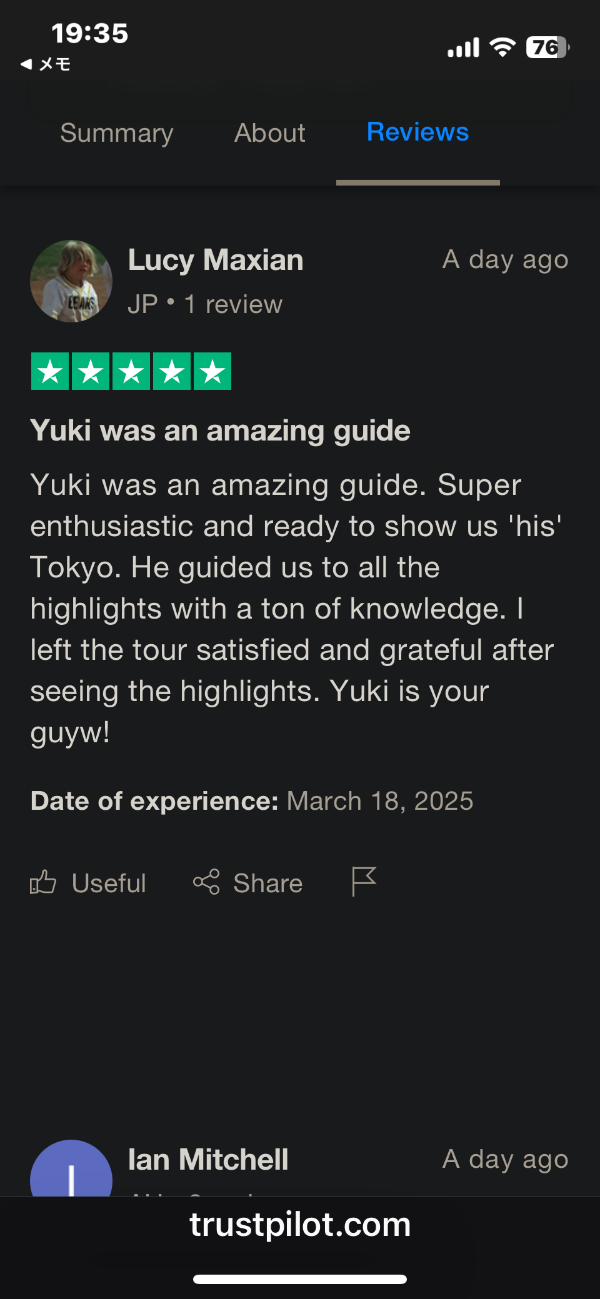
To help Yuki, a professional guide assisting See Jay company, experience how this tour is conducted, I
invited him to join us. During the tour, he shared a story with me that deeply moved me.
That morning, I met Yuki at Tokyo Station at 9 AM. When I showed him the list of participants for the
tour, he pointed out that three of them had been his guests on the Tsukiji Fish Market Tour the previous
day.
For the Tsukiji tour, our company has a lunch budget of 3,000 yen per guest. Wanting to provide the best
possible experience within that budget, Y conducted thorough research and found a long-established sushi
restaurant over 100 years old near the Tsukiji Outer Market. If guests are comfortable with raw fish, he
takes them there for lunch.
The Reality of Lunch Budgets
Although the budget for lunch is 3,000 yen, this sushi restaurant offers a luxurious bento box meal for
3,300 yen. It features an elegant presentation, with sashimi, sushi, and various other dishes served in a
multi-tiered box.
I always want my guests to have the best experience possible, so I personally cover the extra 300 yen out
of my own pocket. Since I love guiding and enjoy working for my son’s company, I see it as part of the
fun.
However, the company’s employees rely on their income for a living. To avoid financial strain, I discussed
the matter with my son, and we agreed that guides should order meals within the 3,000-yen budget. Guests
could simply pay the extra 300 yen themselves, but most travelers don’t carry small change. In most cases,
guides would have to cover the cost, with little chance of being reimbursed since they may never see the
guests again. Given that some tours have over ten guests, this could become a significant burden.
Guides also have their lunch covered by the company, up to 3,000 yen. The restaurant offers a chirashi
sushi bowl for exactly 3,000 yen, while nigiri sushi starts at 3,200 yen.
Choosing a Cheaper Meal to Satisfy the Guests
When I spoke with Yuki about the previous day’s tour, he mentioned that he had guided three guests at
Tsukiji. He let all three of them order the 3,300-yen bento set.
Since the budget is 3,000 yen per guest, this meant an extra 900 yen out of pocket for him. Curious, I
asked, “Did you cover the 900 yen yourself?”
He replied, “No, I spoke with the restaurant staff and found out I could order individual items
separately. So, I chose an assortment of inexpensive sushi rolls, keeping my own meal under 2,100 yen, so
that my guests could enjoy the best bento set available.”
Hearing this moved me deeply.
At 32 years old, this young man was willing to sacrifice his own meal to ensure his guests had the best
experience possible—a level of consideration I hadn’t even thought of at 64 years old. I had always eaten
the same meal as my guests, never considering making such a selfless adjustment.
It made me realize that people with truly wonderful character have a different way of thinking and acting.
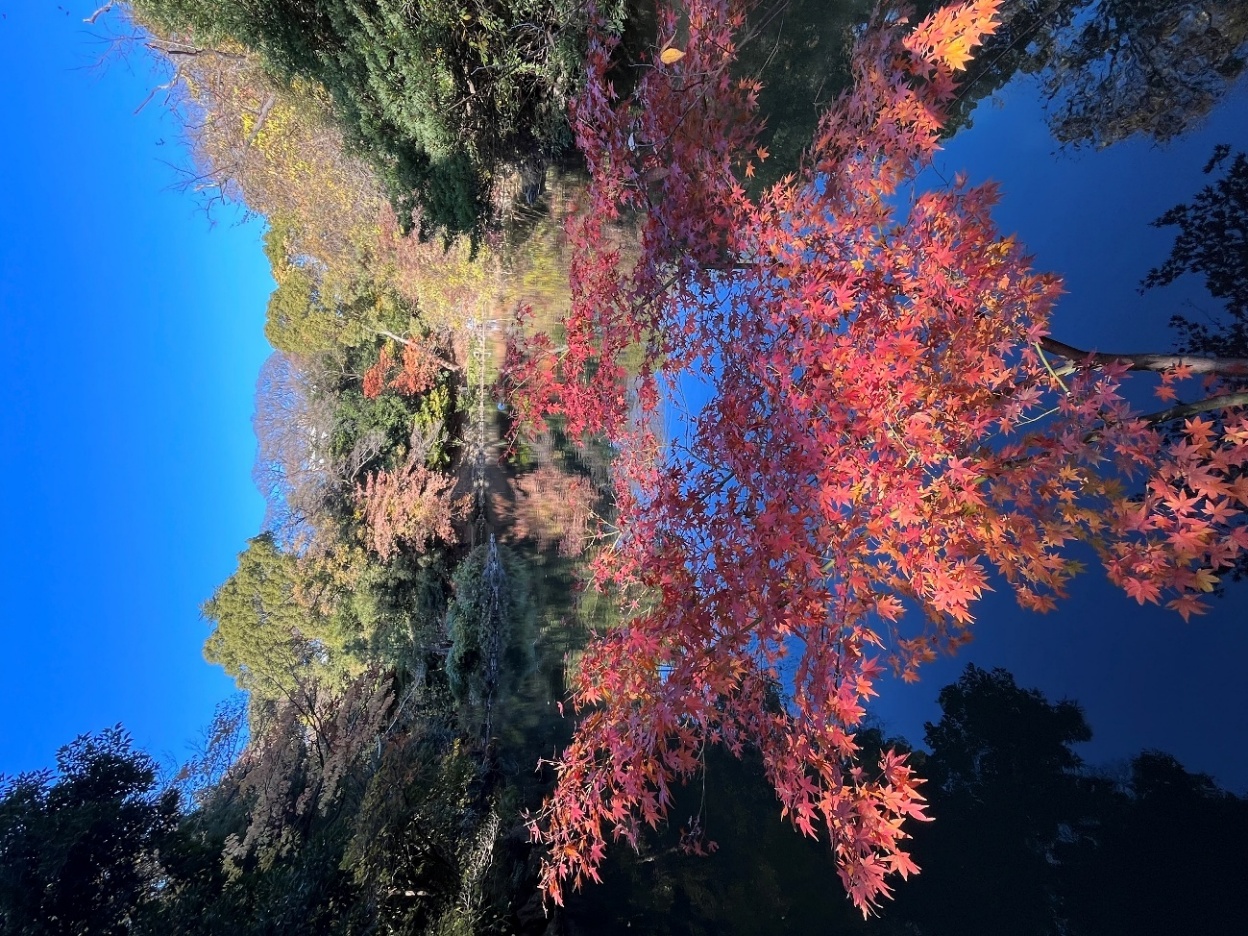
Sanshiro Pond at Tokyo University
Attending to the needs of Orthodox Jewish Guests
I had the privilege recently of guiding a private tour for a Jewish couple visiting from New
York.
Outhodox followers of Judaism observe dietary restrictions known as kosher. Additionally, from sunset on
Friday to an hour after sunset on Saturday, they observe Shabbat, a day of complete rest. According to the
Old Testament, “God created the earth in six days and rested on the seventh,” so they follow this example
and take a day of rest.
Orthodox Jews refrain from using cars or trains on Shabbat. They also do not use any electronic devices,
meaning they spend 24 hours without phones, computers, or television. So what do they do instead? On
Friday night and Saturday morning, they attend synagogue for prayers. The rest of the time is spent at
home with family, enjoying meals, drinking wine, talking, reading the Bible, taking walks, and
napping.
Because of this lifestyle, it is common for Orthodox Jews to marry around the age of 20 and have large
families, sometimes with 10 or more children. In their religious framework, having a spouse and children
is the norm. (This applies specifically to Orthodox Jews; in Israel, many people do not strictly observe
Shabbat in this way.)
Even when traveling abroad, Orthodox Jews stay in hotels within walking distance of a synagogue, as they
cannot use cars or public transportation from Friday evening to Saturday evening. After prayers, they eat
meals prepared according to Jewish dietary laws at the synagogue.
A One-in-Eight-Million Chance
One particular couple arrived at Narita early in the morning, and we met at their hotel in
Shinagawa.
Since they were likely experiencing jet lag, I planned a relaxed itinerary: first, we visited the
observation deck at Shibuya Sky, then had lunch on a bench in Miyashita Park, and took a stroll along the
stylish Cat Street in Harajuku. We then visited Omotesando and explored the stunning jungle-like Tokyu
Plaza building. After that, they returned to the hotel for some rest. In the evening, they walked to the
synagogue for Shabbat prayers and dinner, and afterward, I walked them back to their hotel.
During private tours, I get to have in-depth conversations with my guests. This couple was in their 70s
and had retired. When I asked about their previous profession, the husband told me that he was an
anesthesiologist.
I then mentioned, “My ex-wife was a Jewish New Yorker, and her cousin was also an anesthesiologist.”
The guest asked, “What is his name?”
“Zack,” I replied.
“Is his last name Hillel?”
“Yes, actually.”
“Is he Romanian?”
“Yes, he is of Romanian descent.”
The guest exclaimed, “Oh, Aki, what a coincidence! I worked with Zack as an anesthesiologist at St. Luke’s
Hospital!”
I was astonished. “Are you serious? That’s incredible! New York has a population of 8 million people, and
out of all those people, you happen to know Zack, my ex-wife’s cousin. And here we are, meeting in Japan,
with me as your tour guide! The odds of this happening must be one in eight million. I can’t believe
it!”
From that moment, our connection deepened instantly.
After that, we became comfortable with each other, even joking about how -our kids keep asking us for
money- Conversations became much more personal. Getting to know guests from different countries and
discussing personal topics often makes me realize that, no matter where we are in the world, families
share the same joys and struggles.
The Value of Past Challenge
But the real reason we were able to have such deep conversations was thanks to my ex-wife.
When we were
married, I wanted to do my best to maintain our relationship. She requested that I respect her Orthodox
Jewish observances, so I decided to follow through. I sometimes participated as she fully embraced
Orthodox Jewish life—observing Shabbat every week, meaning no phones, TV, or computers, and no traveling
by car or train from Friday evening to Saturday evening. I initially followed Orthodox Jewish customs to
sustain my marriage, but now that experience has unexpectedly become an asset in my work.
Now, as a guide for Orthodox Jewish guests, that experience has proven invaluable. Also, what I initially
saw as a burden—following my ex-wife’s religious practices—has turned into a strong point in my current
career as a guide.
Even in Israel, only about 20% strictly follow these traditions. In Tokyo, there are very few guides,
Japanese or foreign, who truly understand and can accommodate the needs of Orthodox Jewish travelers,
including Shabbat observance and kosher dietary laws. Paradoxically, because there are now many Chabad
Houses in Japan (with centers in Tokyo, Kyoto, Osaka, Kobe and Takayama), Orthodox Jews although small in
number, make up a large proportion of the Jewish tourists visiting Japan because they know they can get
kosher food and have Chabad to go to for Shabbat and the many Jewish holidays throughout the year.
When Orthodox Jewish travelers have a great experience, they often inform their travel agency, saying,
“This was a wonderful tour, and the guide was excellent.” As a result, I receive direct requests from
several Jewish travel agencies for future tours in Japan.
People often say that nothing in life is wasted. The intense training in Eastern medicine that I endured
in my past has given me the ability to stay calm and enjoy life. That experience taught me an important
lesson: even when something feels tedious or difficult, if you put in your best effort, it will eventually
pay off. I have experienced firsthand how challenges always lead to positive outcomes and exciting
opportunities. But still, there are times when I need to ask for the support of the See Jay team. I
appreciate when Seiji or Elena trouble shoot beyond my capacity. This is the advantage of touring for a
company that works together to support each other. (If you want to be helpful to See Jay staff then this
will show that even you sometimes need the extra help.)
Life is fascinating in that way. And I think the ultimate goal is to reach a point where, even when
something unpleasant happens, you can feel excitement about it because the solution can be found, either
through your own work or teamwork.
Training for Guides
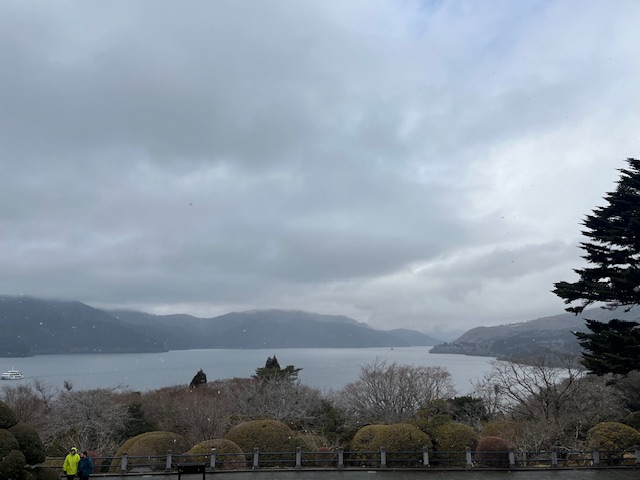
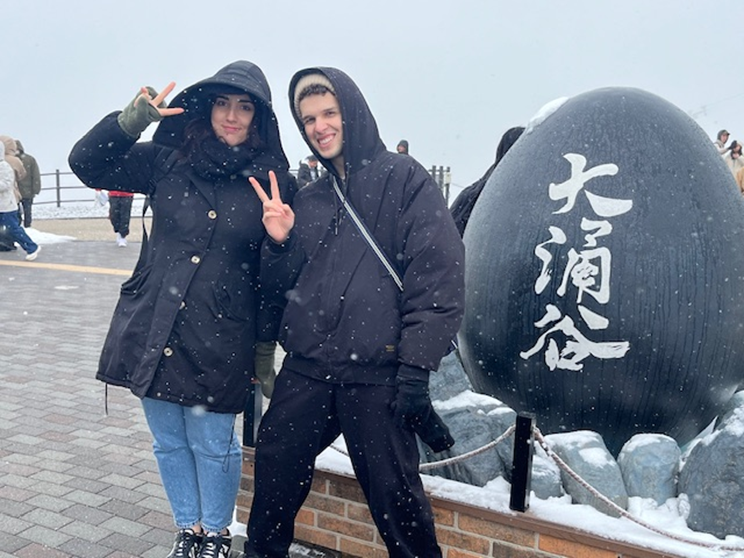
Yesterday, I took Elena from Italy and Vini from Brazil, to Hakone for guide training. Unfortunately, it
was snowing, and we could hardly see the scenery.
I generally enjoy teaching, but until now, my teaching style has been based on the idea that “I know a
lot, so this is the best way to do things.” On-the-job training allows me to share my experiences in a
practical way, enabling trainees to learn things they wouldn’t find just by searching online.
For example, in Hakone when the pirate ship and ropeway stop due to bad weather, I can suggest alternative
places to take guests. I can also teach how to handle unexpected situations by sharing real-life
experiences. The value of training on-site is that trainees can directly learn from someone who has faced
and overcome these challenges before.
Since childhood, my parents took me to Hakone at least once a year, and even as an adult, I often visited
with my family. In a way, Hakone feels like my backyard. However, yesterday, I was struck by the fresh
perspectives of the younger guides.
Zero Visibility Due to Snow
The weather in Hakone was snowy, making it impossible to see Mount Fuji or even Lake Ashi. At
Owakudani,
the clouds and snow were so thick that even the white volcanic smoke was invisible.
How we present a situation to guests can completely change their experience. Normally, if someone visits a
tourist spot and encounters bad weather, they might think: “I came all the way to Hakone, but I can’t see
Mount Fuji or Lake Ashi. Even at Owakudani, I can’t see the volcanic smoke. This is disappointing.”
However, for first-time visitors, they don’t necessarily know what the place looks like on a clear day.
This is where a guide’s skills make a difference.
We saw that,-tourists from hot countries were having snowball fights, taking photos with snow in their
hands, and getting excited about seeing snow for the first time in their lives. They were having so much
fun playing in the snow that they didn’t seem to care at all about missing the volcanic smoke.
Your Positive Perception Creates Your Reality
I told the two trainees: “Today is amazing because we get to see the snow! There are only a
few days in
the year when the scenery is this beautifully white, so we’re incredibly lucky!” By presenting it this
way, guests shift their mindset from feeling disappointed about the lack of visibility to feeling lucky
for experiencing a rare snow-covered landscape. A good guide should be able to naturally express things in
a positive light.
This concept is something I often explain to my patients in Eastern medicine.
Some cancer patients think, “I’ve been told I have three months to live, so it’s hopeless.” Others think,
“I’m a single mother, and my child is only ten years old. I cannot die. The prognosis is just a
statistic—I’m going to beat cancer for my child!”
Even with the same treatment, the results are entirely different depending on the patient’s mindset. Once
you realize that negative expressions attract negative outcomes, you naturally avoid using them. In
Eastern philosophy, it is believed that “Everything that happens in life is a reflection of your own
consciousness.”
This is why, as a guide, it’s essential to always express things positively, regardless of the weather or
situation.
A Young Guide with Great Insight
Then, Vini from Brazil said: “For the guests, this is their first time here, so just being in
this place
must already be exciting. How we present it makes all the difference in their experience. ”I replied,
“Exactly!”
He continued: “People from countries without snow are completely thrilled to see it. The guidebooks
probably say that Owakudani has visible volcanic smoke, but first-time visitors seem to enjoy the snow
even more. So, it makes sense to shift the focus to that. From a typical Japanese perspective, the snow
might feel cold and make the lack of visibility disappointing. But when I first saw snow after coming from
Brazil, I was absolutely ecstatic! Now, I just think it’s cold and annoying, though.” (laughs)
Seeing someone in their early twenties offer such insightful perspectives made me realize that I wasn’t
just teaching—I was also learning from them.
Vini has a strong desire to learn everything he can. Because of that, he takes initiative and asks a lot
of questions, which helps me learn as well. As a Brazilian, he has a natural brightness and a wonderful
personality—no matter how tough things get, he always ends up laughing it off.
On top of that, he handles the company’s accounting meticulously and, together with Elena and Hana-chan,
helps manage the schedule. He’s great with computers and has created various calculation tools that make
it easier for us to report expenses. Though for us older folks (laughs), it’s a bit of a challenge to keep
up with his excellent systems.
One time, we received word that a vegetarian guest would be joining one of his “Tsukiji Fish Market”
tours. Even though the meeting time for the tour was 10 am, he went to Tsukiji at 9 a.m. to look for a
vegetarian restaurant—that’s the spirit of omotenashi (Japanese hospitality).
In Eastern philosophy, it is believed that using your time and energy for the sake of others will
eventually return to you as “toku”—a kind of virtue or spiritual merit.
Everything Happens for a Reason
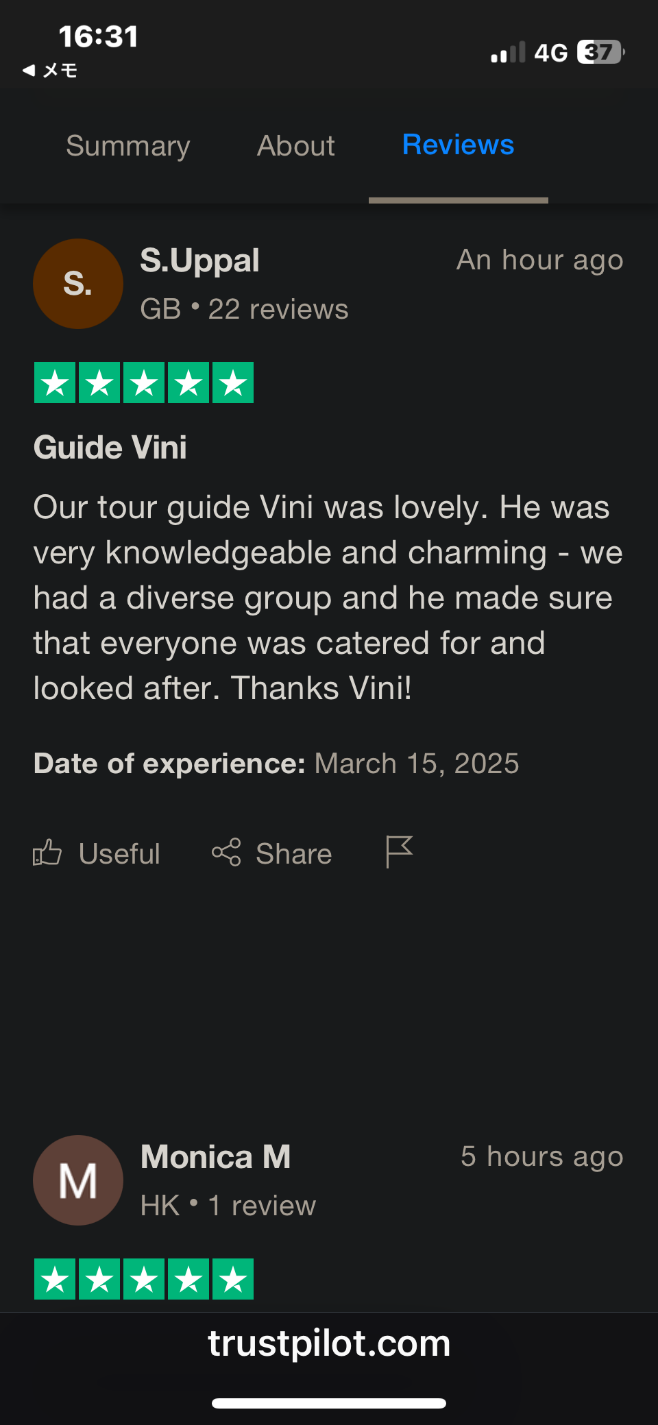
I am grateful to Seiji for giving me the opportunity to work as a guide in my mid-sixties,
allowing me to
learn something new every day while enjoying my job.
Being able to guide guests in English around Tokyo and nearby tourist spots is thanks to the experiences
and people I’ve encountered in my life.
• My American ex-wife, Liane Wakabayashi
• My parents, Toshihiko and Hiroko who took me on many trips as a child.
• A doctor Ogura, who encouraged me to walk every day for my health, which led me to explore all of Tokyo
on foot.
• My children, with whom I traveled to various places.
Because of them, I believe that nothing in life is wasted.
I am also deeply grateful to my mentor, Dr Nobuyuki Takeuchi, who taught me to live with confidence and
composure in any situation. Compared to treating life-or-death patients in clinical settings, dealing with
issues during a tour—such as handling complaints or unexpected problems—feels relatively manageable to
me.
Whenever I face a difficult situation, I remember the patients who, despite my efforts, lost their battle
with cancer. This perspective helps me stay calm, knowing that no matter how challenging a tour problem
may seem, no one’s life is at stake.
The saying “Endure hardships when you’re young, even if you have to pay for them,” is something I have
come to truly understand with age.
Excellent staff and strong support members
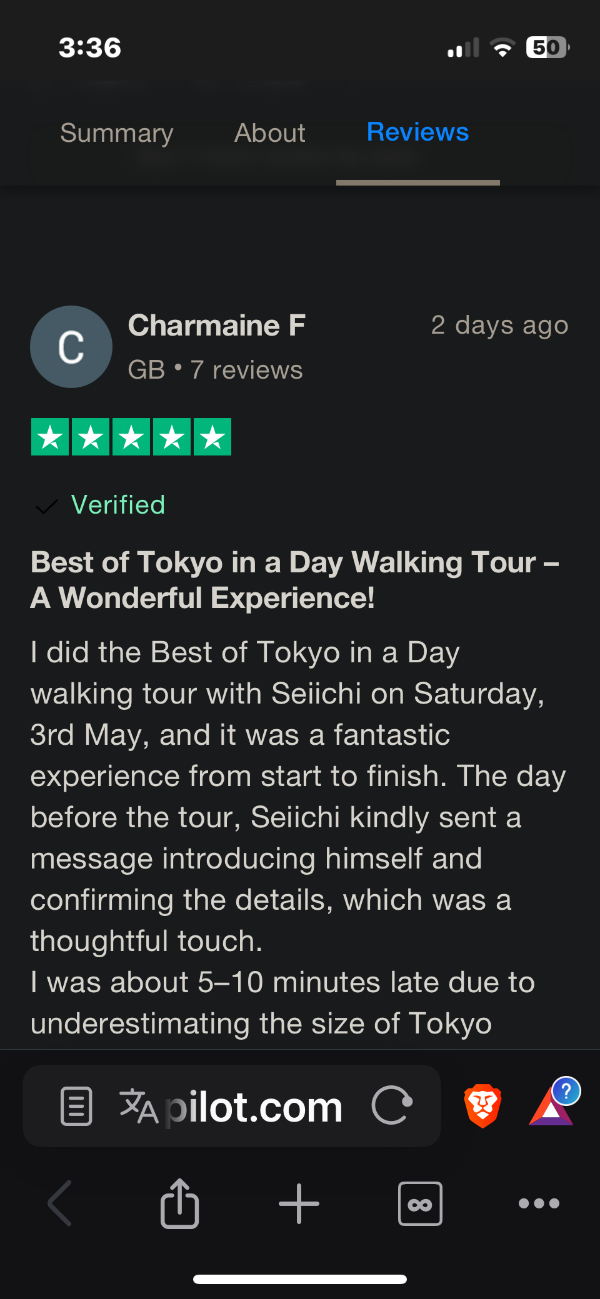
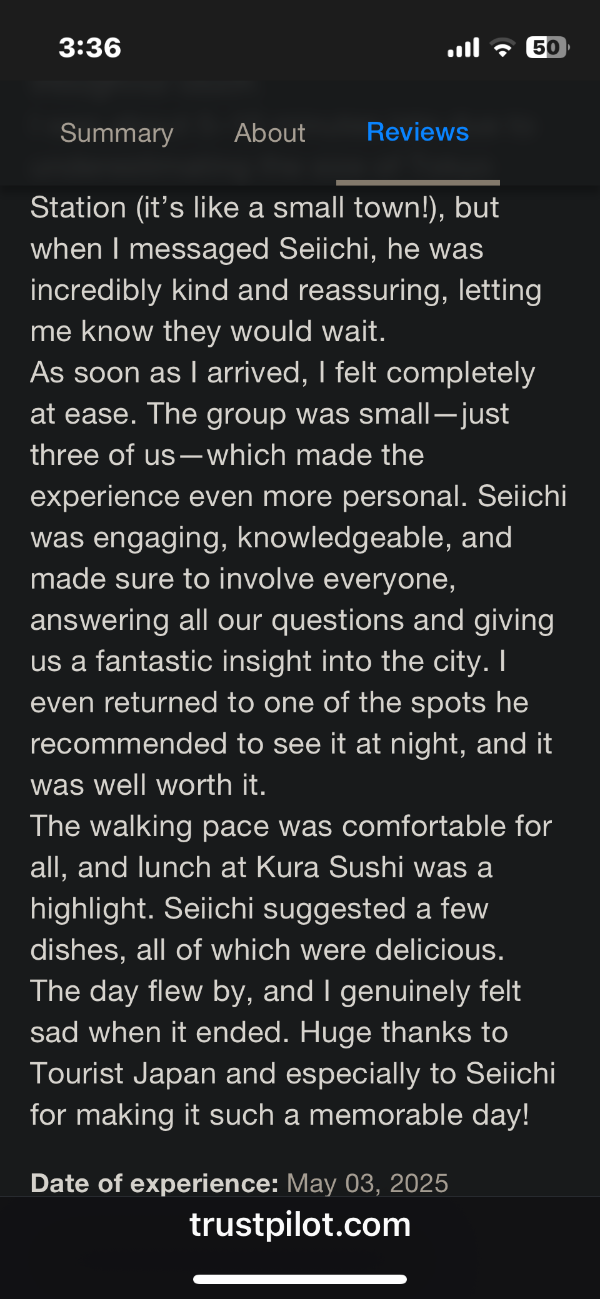
Also, Mr. Seiichi Kobayashi, a close friend of Shuto, is another valuable member of the See
Jay team.
Having traveled to over 30 countries, he now works as both a chef and a tour guide.
Through his experience of hiring guides around the world during his travels, he has thoroughly studied what
it truly means to be a guide from the customer’s perspective.
When you hear him talk about how he guides people based on his own experiences as a customer, it’s
incredibly insightful.
If you ever have the chance, I highly recommend listening to his stories — they can be extremely helpful for
anyone in the guiding profession.
Now, let us introduce a few more of the wonderful people behind See Jay Company:
At the office, we’re supported by Hana-chan, who manages everything with exceptional administrative
skills.
She’s incredibly attentive and reliable.
When there are many guests for the Tsukiji tour and it’s difficult for guides to find restaurants on their
own, she researches Sushi restaurant in advance and makes reservations for us.
When overseas agencies contact us and are unsure about how to plan for Japan, she helps by drafting detailed
itineraries.
Thanks to her sincere and precise work, we rely on her a great deal.
We also receive help from external guides who, while not official employees of See Jay Company, are
indispensable members of our extended team.
Coral, an Israeli guide, is full of talent and positive energy.
She is a true professional, someone we can always count on — especially in challenging situations.
Her Japanese is fluent to the point that if you closed your eyes, you’d think she was Japanese.
She even performs in a punk rock band!
Victor from France has a profound love for Japan and offers uniquely creative guiding experiences.
He has a distinctive atmosphere and guides based on his own personal philosophy, making every tour with him
a learning experience.
During one Tsukiji tour, he showed us the exact spot at Tsukiji Hongwanji where the funeral of X JAPAN’s
guitarist, hide, was held — a place still visited by fans who leave offerings to this day.
He’s a brilliant, delightfully “maniac” kind of guide in the best possible way.
There are many more people whose contributions I cannot list here, but thanks to their support, See Jay
Company thrives.
To all of you — thank you as always.
We deeply appreciate your continued support.
Essential Aspects of Being a Tour Guide
Understanding Your Audience and Presenting Clearly
When guiding a tour, it is crucial to present information in a way that avoids
misunderstandings. For
example, when explaining the Imperial Palace, I say: “Four hundred years ago, Tokugawa Ieyasu unified
Japan, made Tokyo the capital, and built Edo Castle. Then, 150 years ago, during the Meiji Restoration, it
became the Imperial Palace.”
Now, imagine that among the tour guests, there is an American university professor specializing in Edo
culture. From his perspective, my explanation might seem oversimplified. He might even feel compelled to
correct me in front of the other guests by stating historical facts such as: “In 1457, Ota Dokan built Edo
Castle. Thirty years later, the Uesugi clan took control. Forty years after that, the Hojo clan became the
rulers. Finally, in 1590, Tokugawa Ieyasu took over.”
To avoid such situations, I always ask guests questions like:
• “How many times have you been to Japan?”
• “When did you arrive in Tokyo?”
By doing this, I gauge their knowledge of Japan—whether they are familiar with its history and whether
they have visited the sites before. This helps me tailor my explanations accordingly.
If I happen to have a guest like that professor, I might say: “Since exact historical dates are hard to
remember, I use a simplified explanation that states Tokugawa Ieyasu established Edo Castle. I also
incorporate psychological methods to create an immersive experience, allowing guests to feel as if they
are time-traveling to the Edo period—walking in the footsteps of a samurai visiting the Shogun.”
This way, instead of receiving criticism, I often get feedback like: “Your presentation was fascinating
because it had a unique perspective that scholars usually don’t offer.”
Thus, while having a strong foundation in history is essential, it is equally important to adapt your
presentation to your audience. As a professional guide, learning about history and culture is a given.
However, simply reciting history as it is would be a wasted opportunity. Since our guests have traveled
all the way to Japan, wouldn’t it be wonderful if we could share something that enriches their lives?
There are countless ways to do this—find the method that suits you best.
Taking an Interest in People
Another crucial aspect of being a tour guide is having genuine interest in both your job and your guests.
When you care, you naturally start doing things like visiting delicious ramen shops in your free time—so
that when guests ask, “Where can I get great ramen?” you have an answer.
Even if you don’t know a particular place, you can simply look it up online and provide a recommendation.
The ability to offer small acts of kindness like this is what separates a great guide from an average
one.
It’s similar to Shohei Ohtani—he is an exceptional baseball player because he lives and breathes the
sport, both on and off the field. Likewise, presenting Japan’s history and culture is just the starting
point for a guide. Adding a layer of hospitality and thoughtfulness is what truly elevates the experience.
How Communication is Perceived
According to psychological studies, communication is not just about the words we speak. In fact, only 7%
of what we say is conveyed through words.
The remaining 93% is communicated through:
• 38%: Tone of voice and volume
• 55%: Facial expressions, gestures, posture, clothing, and overall atmosphere
This means that no matter how well you study history, if you mumble or lack confidence, your message won’t
be effectively delivered. On the other hand, if you speak loudly, use expressive gestures, and show
enthusiasm, your words will resonate more powerfully.
Some practical tips:
• Speak at twice the volume of your normal conversational tone
• Use exaggerated gestures, even if they feel slightly embarrassing
• Always maintain a smile
Additionally, if you treat your guests as if they were your own family—like guiding your parents or
siblings through Tokyo—you will naturally provide a warm and engaging experience.
Perspective on Work
Finally, I’d like to share a philosophy on work:
“The most important thing is to dedicate yourself wholeheartedly to your daily work. That, in itself, is a
noble path of self-improvement, refining both your soul and character. By immersing yourself in your work
with passion and effort, you are truly cherishing each day and each moment. Life is too precious to waste.
By embracing your work with sincerity and dedication, you naturally elevate your humanity and create a
fulfilling life.”
This passage is quoted from Kazuo Inamori, founder of Kyocera and former chairman of Japan Airlines, from
his book “Ikiru (To Live)”.
This philosophy, deeply rooted in Eastern thought, views work not just as labor or a means to earn money,
but as a spiritual practice that refines one’s soul. By committing fully to your work, you cultivate a
higher level of humanity and achieve a remarkable life.
Let’s continue striving for excellence and walk the path of a fulfilling life!
Aki Wakabayashi
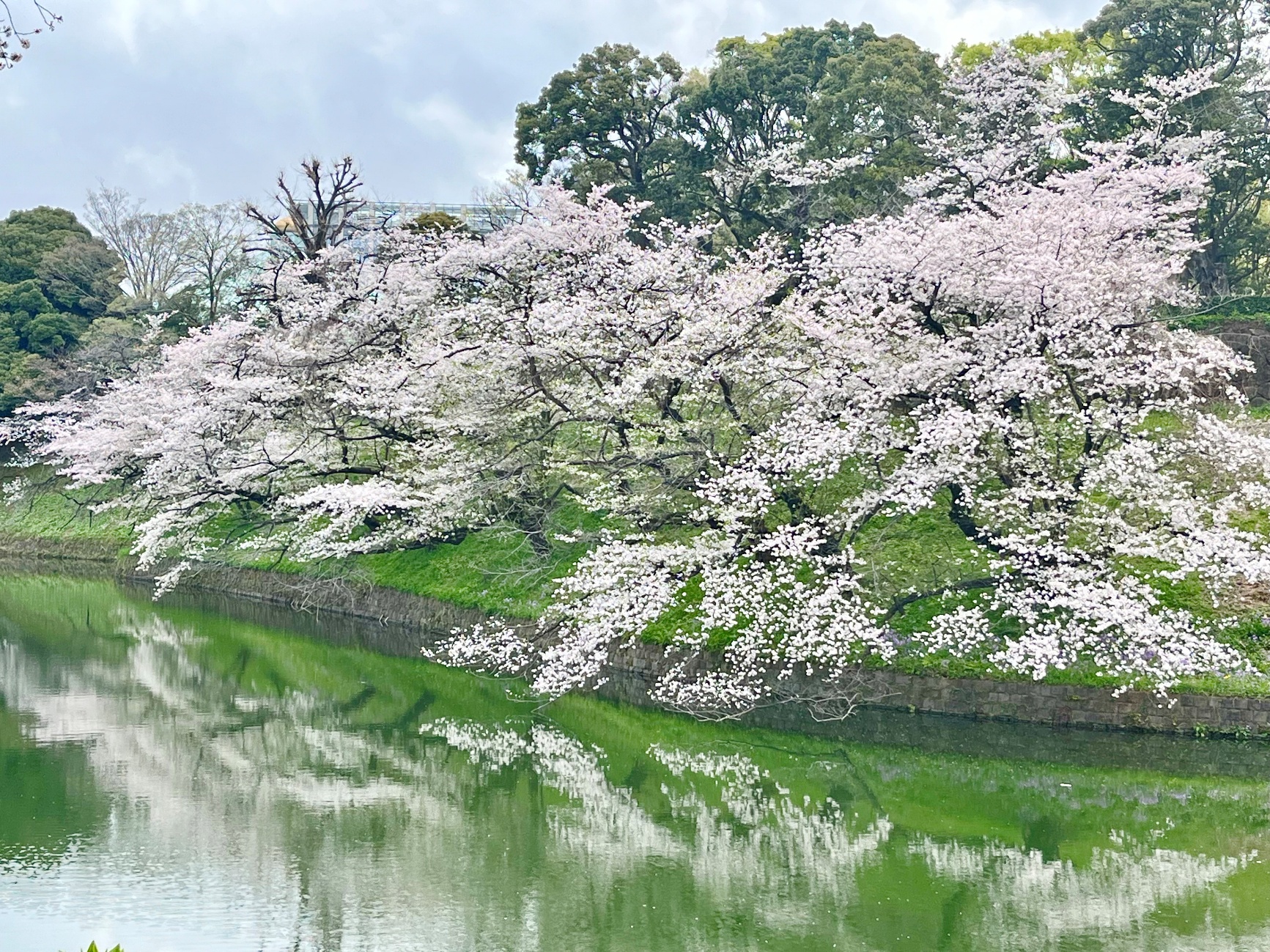 Chidorigafuchi at Impelial Palece